Stakeholders Outline Rail, Green Energy, Digital Reforms For Nigeria’s Maritime Sector Growth
By Asuquo Nuwak
Stakeholders Outline Rail, Green Energy, Digital Reforms For Nigeria’s Maritime Sector Growth
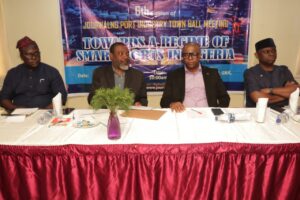
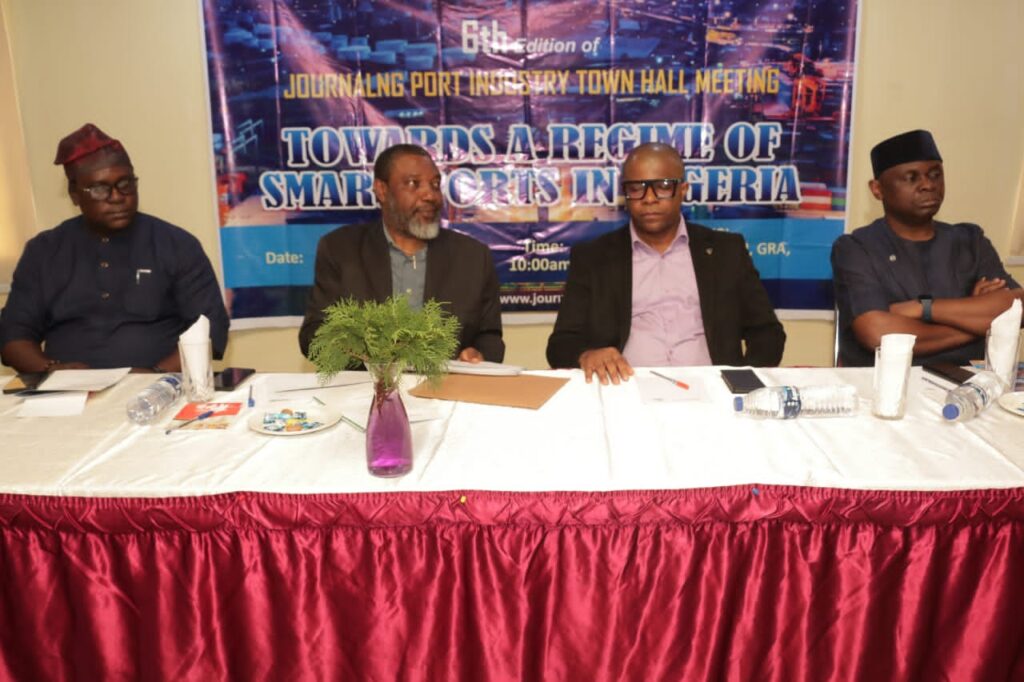
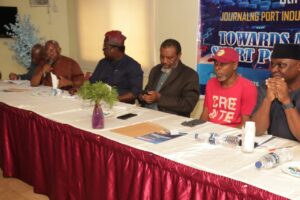
Rockview Hotel, GRA, Apapa, Lagos was filled with distinguished stakeholders, experts, officers and men of Nigeria Customs Service, and gentlemen of the press.
At the event, these distinguished personalities sat glued to their seats listening to discussions by stakeholders in Nigerian maritime industry on the need for rail connectivity, green energy adoption, and digital integration as critical pillars for unlocking growth and achieving a fully functional smart port system.
In their speech, the maritime experts cautioned that without coordinated investments in logistics infrastructure, reliable power supply, and technology-driven operations, the country’s ports may not meet global competitiveness standards.
The experts made these remarks during a panel session at the 6th JournalNG Port Industry Town Hall Meeting held recently in Lagos, themed “Towards a Regime of Smart Ports in Nigeria.”
Commenting during the event, the Managing-Director of Inland Containers Nigeria Limited (ICNL), Omotayo Dada said Nigeria cannot achieve a true smart port regime without fully integrating seaports with Inland Dry Ports through rail connectivity and cargo visibility systems.
Commenting further on the role of Inland Dry Ports in modern port operations, Dada noted that the Kaduna Inland Dry Port and Nigeria’s dry port system have moved beyond the planning stage to active operational capacity, contributing to trade facilitation across the country’s hinterland.
Significantly, he said Kaduna Inland Dry Port handled about 8,320 Twenty-foot Equivalent Units (TEUs) within the past years, demonstrating growing utilization of inland cargo facilities.
Still, he revealed that the Kaduna Inland Dry Port, designated in 2015 and commissioned in 2018, remains Nigeria’s first fully operational Inland Dry Port, playing a vital role in decentralizing cargo movement and reducing pressure on Lagos seaports.
Indeed, Dada emphasised that discussions about smart ports in Nigeria must go beyond technology deployment to include integrated logistics systems that align people, processes, and infrastructure.
Omotayo Dada is quoted as saying that: “If we are having a smart port that has not successfully integrated the seaport to the Inland Dry Port through rail, through cargo visibility, then we have not started. From my point of view as an Inland Dry Port operator, that Inland Dry Port model is open for business. It depends on a lot of feedback from Lagos to bring trade to other parts of Nigeria”.
Besides, he noted that Inland Dry Ports have already begun shifting cargo traffic from coastal areas to inland regions, enabling traders to conduct business closer to their operational bases without frequent travel to Lagos.
Beyond this, Dada explained that effective rail connectivity between seaports and Inland Dry Ports, supported by digital cargo tracking and optimisation systems, would significantly enhance Nigeria’s trade competitiveness.
In his comment, a master mariner and former general manager of the Nigerian Ports Authority, Captain Iheanacho Ebubeogu, called for the inclusion of environmental sustainability and marine operational systems in Nigeria’s push toward smart port development.
The maritime expert who urged stakeholders to adopt a dual approach that combines digital efficiency with environmental responsibility, smart and green ports, also noted that ports of the future must embrace sustainable practices to address climate change challenges.
Accordingly, he said green port development aligns with global directives from international maritime bodies such as the International Maritime Organization (IMO), which advocate the use of environmentally friendly technologies in port operations.
Additionally, Captain Ebubeogu explained that modern port equipment should be powered by low-emission or renewable energy sources, pointing out that within the next decade, ships calling at ports would increasingly be required to shut down onboard generators and connect to shore-based power systems powered by clean energy.
Beyond all these, he noted that such measures would significantly reduce carbon emissions and position Nigeria’s ports to meet emerging global environmental standards.
Aside from environmental concerns, Ebubeogu emphasised that smart port development must also incorporate critical marine operational components, including Vessel Traffic Services (VTS), fire protection systems, and electronic harbour management.
Furthermore, he highlighted the importance of establishing a port marine information system, which would enable harbour masters and pilots to communicate electronically with incoming vessels, improving navigation safety and operational efficiency.
The maritime expert also stressed the need for seamless collaboration between port authorities and digital system operators to ensure the success of Nigeria’s National Single Window initiative.
Captain Ebubeogu, who drew attention to the importance of improving logistics infrastructure surrounding port locations, particularly roads within port corridors, also explained that port logistics rings must remain free of traffic bottlenecks and supported by well-maintained access roads to ensure efficient cargo movement.
Commenting further, the Association of Maritime Truck Owners (AMATO) attributed recent increases in haulage rates to the rising cost of diesel, while outlining plans to modernise trucking operations to align with Nigeria’s transition to smart port systems.
Adesina Ajibola, who represented the Chairman of AMATO, Remi Ogungbemi, said current trucking charges are primarily survival-driven rather than profit-oriented.
He explained that the high cost of diesel, currently around ₦2,000 per litre, has significantly influenced transport pricing across the maritime logistics chain.
According to him, truck operators have been charging minimal rates necessary to sustain their operations and maintain assets, noting that a reduction in diesel prices would likely result in a corresponding drop in haulage charges.
He stated that if diesel prices fall to previous levels of about ₦960 to ₦1,000 per litre, trucking rates could return to a range of ₦200,000 to ₦300,000.
Ajibola further noted that many truck owners have historically failed to adequately account for asset depreciation, maintenance costs, and operational risks, warning that neglecting such factors increases safety risks and accident potential within the transport sector.
In his presentation on smart ports, he highlighted the need for truck operators to align with the broader digital transformation of the maritime industry.
He disclosed that AMATO began repositioning its operations about two to three years ago following engagements with key government agencies, including the Nigerian Ports Authority, to prepare for the emergence of smart port systems.
Accordingly, he said the association identified several strategic projects designed to integrate trucking activities into a smarter maritime ecosystem and prevent congestion in emerging logistics hubs such as Inland Dry Ports.
Importantly, Ajibola warned that without proper planning and smart systems, congestion challenges currently experienced around Lagos ports could simply be transferred to inland cargo facilities.
Adesina Ajibola, who announced that AMATO is currently pursuing a Public-Private Partnership (PPP) arrangement to develop a smart truck park, which is expected to commence soon, also disclosed plans for fleet renewal initiatives and driver retraining programmes aimed at improving safety standards and operational efficiency among truck drivers.
Additionally, Ajibola said the association is working on the rollout of an integrated haulage digital platform to enhance coordination among trucking operators and stakeholders within the maritime supply chain.
In his contribution, the Dean of the School of Eloquence and founder of Blue Economy TV, Ubong Essien, emphasised the need for reliable power supply, telecommunications infrastructure, and cross-sector collaboration to support Nigeria’s transition to smart ports and a sustainable blue economy.
Drawing from recent experience, Essien cited operational challenges encountered during the institution’s attempt at the longest public speaking guinness world record marathon attempt by the School of Eloquence, noting that unreliable digital infrastructure significantly affected post-event processes.
Accordingly, he said the institution relied heavily on internet systems to transmit video recordings during the marathon, yet continued to experience difficulties several days after the exercise due to weak connectivity.
He explained that if a single institution could face such digital constraints, the implications would be even greater within the complex port ecosystem, where uninterrupted connectivity is essential for smart port operations.
Still, Essien stressed that reliable electricity supply remains central to the success of smart port systems, urging greater involvement from power sector stakeholders such as the Eko Electricity Distribution Company and other energy providers.
He noted that without stable electricity, digital port operations, cargo processing systems, and smart logistics platforms would struggle to function effectively.
Besides, the Dean also highlighted the importance of expanding participation in Nigeria’s blue economy by involving professionals from diverse sectors beyond maritime operations.
Accordingly, he said the blue economy concept should encourage collaboration among experts from finance, technology, telecommunications, and energy sectors to strengthen maritime development.
About The Author